
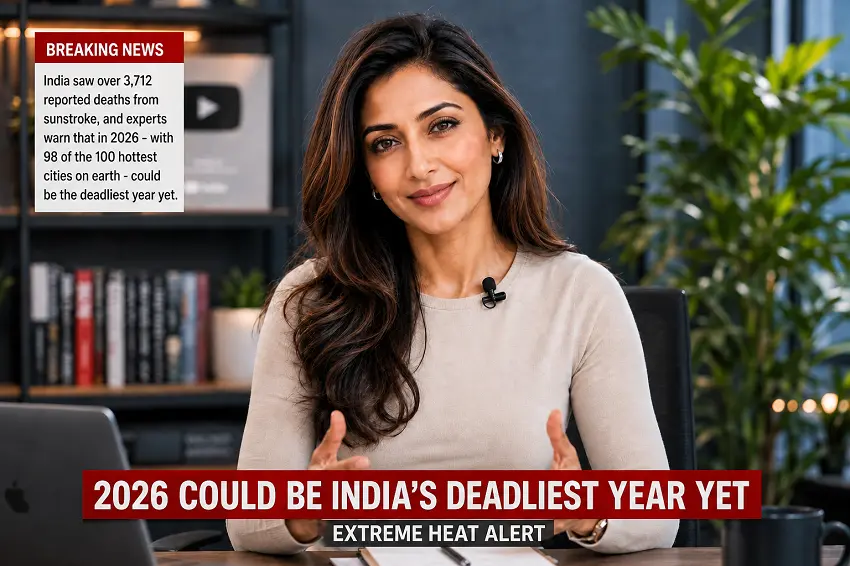

India saw over 3,712 reported deaths from sunstroke, and experts warn that in 2026 – with 98 of the 100 hottest cities on earth – could be the deadliest year yet.
Think about the summers you have grown up with. Now hear this. 2024 was the hottest year India has recorded since 1901. Then 2025 came. And our winter – our actual winter – was the hottest in 124 years. Heatwaves arrived in February. In Goa. In Maharashtra. That has never happened in the history of Indian weather records. Not once. And the last ten years? Every single one of them is among the warmest India has ever seen. All ten. In a row. This is not a bad summer. This is a climate emergency – and it is already here.
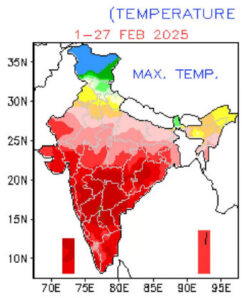
India recorded its 8th warmest year in 2025. But February 2025 was the hottest February in 125 years. Night temperatures rose 3–5°C above normal across 22 states in a single fortnight — in winter. (Down to Earth, Jan 2026)
India’s average temperature has risen ~0.89°C above the 1901–1930 baseline. Projected additional warming of 1.2–1.3°C by mid-century under moderate emissions scenario (SSP2-4.5).
This is happening right now, in 2026, as you watch this. 98 of the world’s 100 hottest cities are in India. Ninety-eight. Akola touched 46.9 degrees. Amravati, 46.8. Banda, 46.6. And the reason it is this severe this year is El Nino – a climate pattern in the Pacific Ocean that, for India, means one equation: less rain, more heat, heatwaves that last longer. Our own IMD has warned of a 31% chance of a below-normal monsoon in 2026. We have already recorded 60% below-normal rainfall in January and February. Think about what that means for your water. For the food on your plate. The ground is dry before summer has even peaked. And we are not close to the end.
Here is something to think about. The Ganga. The Yamuna. The Brahmaputra. The rivers this civilisation was built on. They are fed by Himalayan glaciers. And those glaciers are now melting 65% faster than they were just one decade ago. In 50 years, we have lost ice equal to 24 metres of water depth — gone permanently. The Gangotri glacier has retreated nearly 2 kilometres since 1780. If warming continues on this path, the Eastern Himalayan glaciers could lose 75% of their volume by 2100. One point six billion people across India, Pakistan, Bangladesh, Nepal — they all depend on this water. When the ice runs out, it does not return. We are left with rivers that flood violently in monsoon and go dry in summer. That is not a distant future. That is the direction we are moving in right now.
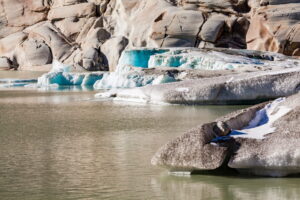
Cumulative glacier ice loss from 1973–2023 equivalent to ~24 metres of water depth.
Gangotri Glacier has retreated 1,860 metres since 1780.
At 3°C warming — the current policy trajectory — Eastern Himalayan glaciers could lose up to 75% of their volume by 2100.
1.6 billion people depend on Himalayan meltwater. When the ice is gone, the seasonal water cycle breaks permanently.
And here is the part we do not talk about enough. Heatwaves do not just kill people directly. They raise the death rate across the entire population – silently, without headlines. A peer-reviewed study across ten Indian cities found that on extreme heatwave days, daily all-cause mortality rises by nearly 15%. That means more heart attacks. More organ failures. More pregnant women losing their babies. More elderly people who simply do not wake up. The bodies do not say ‘died of heat’ – so they are never counted. And going forward, scientists project that by 2050, heat-related death rates in India could increase by 6 per 100,000 people annually – that is an additional 100,000 deaths every year, on top of what we already see today. One hundred thousand lives. Every year. From the heat.
And here is what most difficult to accept. India produces just 4% of the world’s carbon emissions. Four percent. The United States and the European Union together caused 50% of all the carbon that has ever been pumped into this atmosphere — two centuries of burning coal and oil to build their wealth. We contributed almost nothing to this crisis. And yet India is one of the ten most climate-vulnerable nations on this planet. Our farmers, our construction workers, our urban poor — they are absorbing consequences they did not create. That is not misfortune. That is a structural injustice. And it needs to be named as one — in every climate negotiation, at every international table.
India projected to lose up to 3.2% of GDP annually by 2100 due to climate impacts.
In June 2025, India crossed 50% of its electricity capacity from clean energy – five years ahead of our own target. On July 29, 2025, on one single day, more than half of everything India consumed electrically came from the sun and the wind. We are now the world’s third largest solar power producer. In one generation, this country moved from energy scarcity to leading the world in clean power. We know how to move fast when we decide to. That same urgency now needs to go into protecting our people from the heat, our rivers from disappearing, and our farmers from ruin.

- Protect and Plant Trees. In cities that have lost green cover, temperatures run 3 to 5 degrees higher than areas with tree canopy. Safeguard the old trees from being cut costing the ecosystem.
- Save water like its currency. Because India’s per capita water availability is projected to fall 42% by 2050, and 60% of our rainfall this January and February was already below normal. Every litre saved is not a small act. It is a civic duty.

- Keep yourself hydrated. Follow Govt Heat Plan – avoid planning outdoor events at the hottest time of day (12PM-3PM). Use the maximum of govt cooling shelters.
- Lastly, Demand climate justice at the international level.
Because the summers of the future… the ones our children will live through… are being decided in this very room, in this very moment.
India didn’t create this crisis. But we are the ones who will end our role as its victim. We have the power to refuse to be its casualty.
Conclusion:
The numbers in this story are not distant projections or abstract climate charts. They are the reality of the world we are already living in.
India’s summers are changing faster than any generation before us has experienced. Rising temperatures, disappearing glaciers, longer heatwaves, and shrinking rainfall patterns are not isolated problems — they are all parts of the same climate system under stress.
The science is clear. The evidence is overwhelming. And the consequences are already visible in our cities, our rivers, our farms, and our hospitals.
But this story is not only about crisis.
It is also about responsibility and action.
India has shown that transformation is possible. Crossing 50% clean electricity capacity ahead of schedule and becoming one of the world’s leading solar producers proves that large-scale change can happen when there is political will, technological investment, and public participation.
The next phase of the climate fight is not just about reducing emissions. It is about protecting people — building cooler cities, conserving water, restoring forests, and preparing communities for a hotter future.
The choice is ours. While we still have one…